Thursday, 21 April 2016

Anzac bridges to link commemorations

Thanks to the Wairarapa Times-Age for this article on the Anzac Bridge project. 

"At the Anzac Day service here, we will read out a message from Brooweena and the names of the Broweena soldiers and they will read out a message we send to them and the names of our soldiers at their Anzac commemoration."

I've seen both these messages and I think they are both going to be very powerful and affecting tributes. I won't divulge their contents yet, but will post the text here after the Anzac Day services. 

I'm also looking forward to posting some of the wonderful artwork and poems by the children of the schools,  both here and in Queensland. 
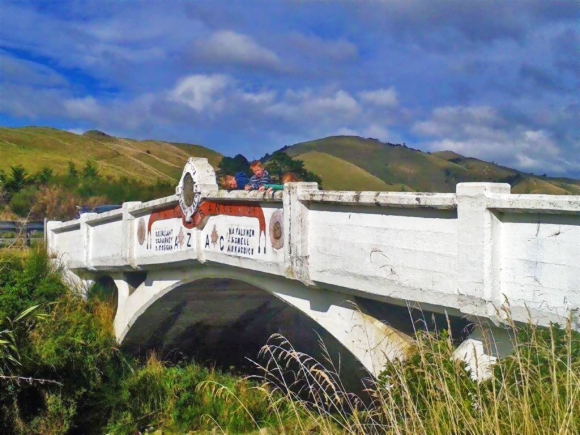
The Anzac Memorial Bridge at Kaiparoro in Wairarapa. PHOTO/FACEBOOK
he Anzac Memorial Bridge at Kaiparoro in Wairarapa. PHOTO/FACEBOOK

Visiting ANZAC memorial bridge

Recently I came across this lovely post about a family visit this time last year to the Anzac memorial bridge. 

This family stopped at the bridge, took a moment to stand there and "reflect on its significance", looked for eels in the swimming hole underneath and explored the bush walk in the nearby W A Miller scenic reserve. A week later, they returned so their children could take part in the Anzac Day service. 

"Having the chance to visit special memorial sites such as the ANZAC Memorial bridge helps to develop an understanding for them of what they are commemorating."

"Checking out the bridge" 

Monday, 18 April 2016

The Anzac Bridge Felllows

One of the (many) special things about the Anzac Bridge Fellowship is feeling that you are carrying on a tradition of previous artists' or writers' work, so here are some links to previous Fellows from the last few years:

2015: Connah Podmore's Writing to History project invited members of the community to write a postcard to a war time ancestor (not necessarily a soldier - one boy wrote a letter to a donkey!) Her own postcard was written to Alfred Falkner,designer of the bridge, because of a feeling of connection to him as a fellow maker of memorials. The postcards were collected and featured in a video work and installation shown at Pukaha Mt Bruce on Anzac Day 2015.

2014: In the Harakeke Poppy Remembrance Project, Anna Borrie created a 10m long cloak made of white rata vine and featuring 800 harakeke (flax) poppies. People from the community helped to make the cloak, which was draped over the bridge at the Anzac Day service.  (Fabulous photos of the 2014 Anzac Day service here and here.)

The artist and descendents carry the cloak onto the Bridge

2013: Lucy Jerram Moore had already worked on a collaborative exhibition called War cry /Letters home. You can see her lovely water colour of the bridge here.


Just an orange for Christmas: memories of war

Chris Daniell is on the Board of NZ Pacific Studio and she was the one who took me over to Mauriceville School (including negotiating her way past a herd of cows going for milking with much more skill that I would have managed!)

Chris has written several wonderful books including Just an orange for Christmas: stories from the Wairarapa (HarperCollins, 2013).  I found a copy on one of the many bookshelves here, and was entranced by her interviews with ordinary people who often have extraordinary stories. One of the most captivating speakers was Evie, a centenarian born in Pahiatua who told stories such as walking to school along a track that her uncle marked with hatchet marks cut into the trees so she knew which way to go, and the instruction: “You must never speak to anyone who comes onto this track Go and hide.”

Evie could remember the outbreak of the First World War and told a story about it which I’ve asked Chris if I can reproduce here:

"I’ll tell you something: I remember the outbreak of the First World War. I clearly remember my cousin Charlie going away to the war when I was eight. I used to worry about which men and which horses would get shot. Now they just bomb everything, don’t they? Charlie was only eighteen. He put his age up so he could go. Well, all one night his dogs howled and howled - they didn't just make a noise, they howled.  I said, “What are the dogs making all that noise for?” All I got told was: “We’ll know tomorrow.” I remember that very clearly: “We’ll know tomorrow.” Next day the telegram came. Charlie had been captured. His dogs knew. Once the man came and delivered the telegram, the dogs shut up. You wouldn't think, across the other side of the world, they could know. But they did.

Yes, Charlie did come back in the end. The dogs? I don’t remember how they reacted when he got back home. It sounds as if I've dreamt it all, but I haven’t.

Evie was born in 1905, so she would have been about nine at the start of World War One. Hearing someone talk about the war like this seems to bring it much closer.  


Sunday, 17 April 2016

"I hope this time next year I will be back in Pig Island, it will do me..."

On Sunday, I went to see the exhibition at Aratoi, Wairarapa's Museum of Art and History (what a wonderful mix) on the Featherston Military Training Camp. These are just some of the stories from World War One that stuck in my mind:

Dr William Bey, superintendent at the nearby Greytown Hospital, cared for the soldiers who were admitted there. He died in the influenza epidemic of 1918, three months after his son had been killed in France. I think this must have been his son: William Farquharson Bey who died at Bapaume on 25 August 1918 and is one of the soldiers remembered at the memorial gates and avenue of lime trees in Greytown.

Private Norman Christopher enlisted on 5 January 1916. He entered Featherston Camp and died there under anaesthetic at the dental hospital on 23 February 1916. (Many soldiers had work done on their teeth before leaving for overseas. Perhaps this was just a routine operation.)

The Featherston memorial panel for soldiers who died at the Military Training Camp
during World War One, 

Leonard James Aplin, who joined up in 1917 and wrote letters that give a very evocative picture of a soldier's daily life:

2 December 1917, Ocean wave: "On the afternoon we left, there was someone waving out of nearly every house in Wellington."

10 February 1918, Sling Camp: "I hope this time next year I will be back in Pig Island, it will do me... "

25 October 1918,No 2 NZ General Hospital, Walton-on-Thames: "Alex Gray from East Taratahi came in last night, we had been in a London hospital. He told me old Billy Bey was killed. What a lot of Carterton boys have gone out..."

I've just realised now, looking at the name and the date, that he must have been referring to William Bey, mentioned above.


Tinui: "They lie dead in many lands that we may live here in peace"

On Saturday I went to Tinui, a little village on the road from Masterton to Castlepoint. It's a beautiful drive from Kaiparoro, and a very special place to visit, because Tinui held the world's first Anzac Day service - an astonishing piece of history for such a tiny settlement (population 27, according to the locals at the pub).

On 25 April 1916, a year after the first landings at Gallipoli, Rev Basil Ashcroft held an Anzac service at the Church of the Good Shepherd and then, with others from the local community, climbed the hill behind the village to erect a cross on the top of it. The original cross was wooden and had to be replaced in 1965, but today the Tinui cross still overlooks the village, with its church and war memorial hall.

You can read more about the Anzac connection here, together with the plans for this year's Anzac Day commemorations. Rev Ashcroft's great grandson is going to present the Anzac address - that's pretty amazing.
T
The view from the village: the cross is at the top of Mt Maunsell,
just past the stand of trees on the left side of the crest of the hill, 

The Church of the Good Shephered


"They lie dead in many lands that we may live here in peace"

My favourite road sign at Tinui 


The Tinui cross

I've known about the Tinui memorial cross ever since writing about it for my book on the history of Anzac Day, but I've never been there before this weekend.

Tinui (population 27) is a small village on the road from Masterton to Castlepoint. The walk up to the cross is a steep one, as the notice at the bottom warns you, but the view at the top is totally worth it. You can click here to download a pamphlet about the walk.

The Tinui cross makes up another very special part of the Wairarapa's World War One history, and the people of Tinui take its place in history seriously. Next Monday, lots of then will be heading up there for the Anzac Day dawn service.


Lots of these on the track

More great signage


View of Tinui